Atomistic Intelligence Lab is building toward an Agent-Driving Lab (ADL)—our term for a research environment where AI agents connect hypothesis generation, simulation, analysis, and experimental feedback. We collaborate across chemical-engineering applications while developing an independent methodological core in MLIP infrastructure, scientific agents, and research automation. Agents expand the space we can explore; researchers remain responsible for choosing meaningful questions and validating the answers.
Experiment as Ground Truth
"No matter how beautiful the theory is."
- R. Feynman (1964)Adopt AI Responsibly
Take responsibility for the quality of AI-generated outcomes.
Agent-Driving Lab
Scientific agents coordinate candidate generation, simulation, analysis, and experimental feedback. We develop practical closed loops that enlarge the searchable design space without overstating full autonomy.
ICLR 2026 AI4MatChem. Eng. J. (2024)
ACS Energy Lett. (2025)
AI Infrastructure
We make atomistic foundation models lighter, faster, easier to adapt, and more consistently evaluated. Distillation, efficient finetuning, benchmarking, and standardized agent interfaces form the methodological core of the lab.
AI4Mat-NeurIPS (2025)Cell Rep. Phys. Sci. (2025)
Nat. Sensors (2026)
Collaborative Applications
We pursue independent scientific questions with experimental collaborators across catalysis and energy materials—from thermochemical and electrochemical conversion to emerging homogeneous systems.
Heterogeneous & homogeneous catalysisEnergy materials · AI4Chem
We will build sustained relationships across three communities: KIChE and KSIEC as our core chemical-engineering societies; KIM for the computational materials community; and ICML, ICLR, and NeurIPS for the international AI community. The aim is to connect application-driven chemical engineering with rigorous atomistic modeling and frontier AI methodology.
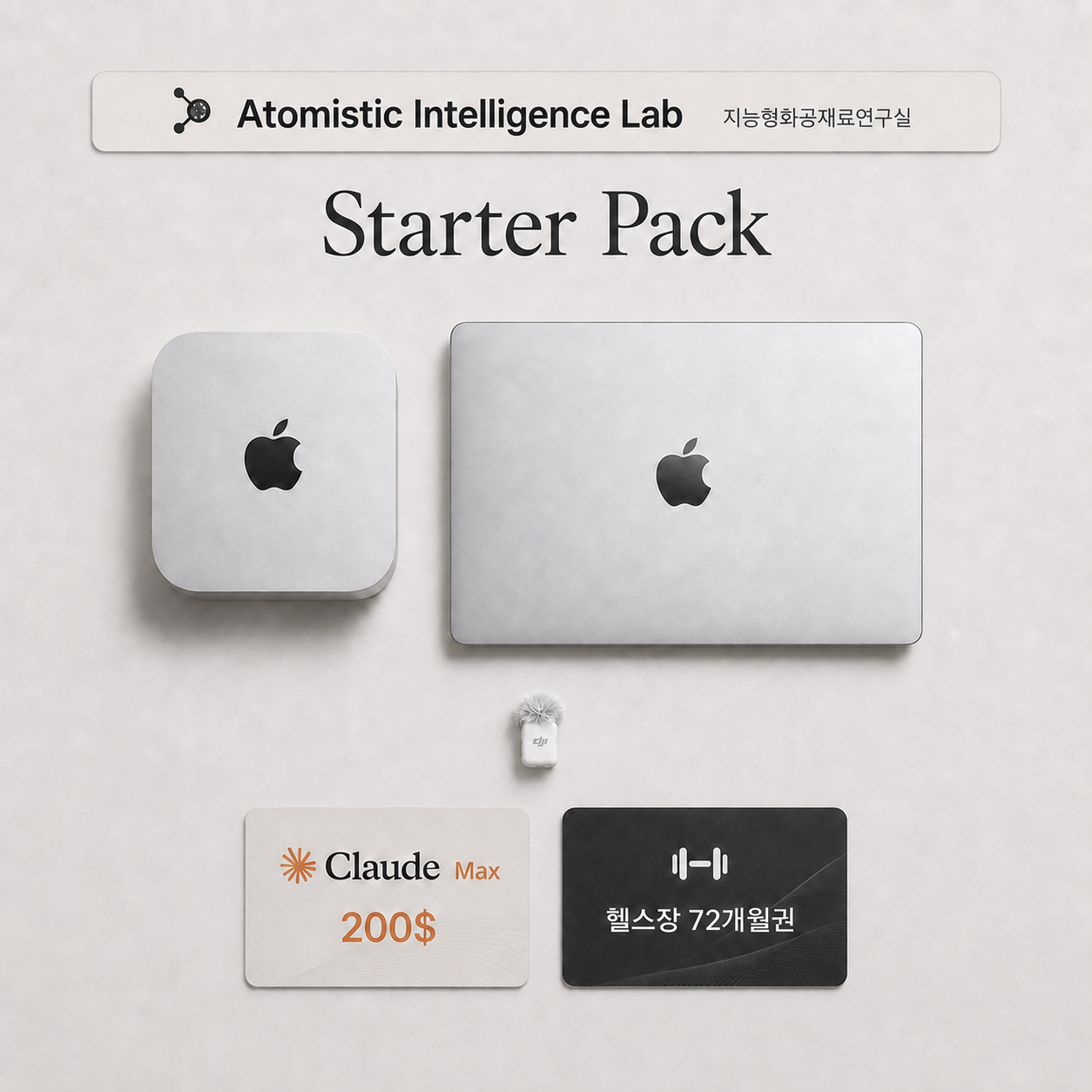
For Your Research
- Claude Max for every lab member
- GPU clusters (A6000/L40S, H100 via KISTI)
- VASP, LAMMPS, PyTorch, ASE, custom tools
- Direct experimental collaborator connections
For Your Life
- Gym membership (we pay for it)
- Flexible working hours (output > hours)
- Unlimited deep discussions with Dr. Choung
- 1-on-1 mentoring for YOUR career goals
- Asking "why?" is encouraged, not punished
Interested?
Graduate students, postdocs, and undergrads all welcome. No simulation experience required.
No formal deadline. Positions open until filled.